1. Transmission speed
The quality of twisted pair is one of the key factors that determine the LAN bandwidth. Some manufacturers wrap the pairs used in Category 3 or Category 4 UTP cables in Category 5 UTP cables, which is difficult for ordinary users to distinguish. The so-called "five types of UTP" cannot reach a data transmission rate of 100Mbps, with a maximum of 10Mbps or 16Mbps. A simple identification method is to use a twisted pair to connect two 100Mbps devices (network card to network card or network card to HUB), and use the monitor detection tool provided by Windows 95/98 to monitor its data transmission rate during communication
The method is:
① Select Start → Programs → Accessories → System Tools → System Monitor, and the System Monitor window will appear. If there is no "System Monitor" tool in "System Tools", it can be established through "My Computer → Add/Remove Programs → Windows Installer → System Tools → System Monitor"
② Set monitoring objects in the System Monitor window. Select the "Add Item" option in the "Edit" menu, select "Microsoft Network Server" or "Microsoft Network Client" in the "Category" list of the dialog box that appears (note: under the condition that the network connection is normal), and select "Bytes written/second" or "Bytes read/second" in the next dialog box. As for the choice of "Microsoft network server" or "Microsoft network client", or "bytes written/second" or "bytes read/second", readers can choose at will, because the data sent by one node in the network should be equal to the data received by the other node
③ Set the output mode of test data. The system provides three output modes: line chart, bar chart and digital chart, which can be selected through the buttons in the window toolbar
④ Perform the test. The most effective way is to copy a large number of files from the server to the workstation where you are testing (in order to test the accuracy, the copied content must be enough). Generally speaking, if the displayed peak value is more than 4M/s, it is almost certain that it is a five-category network cable (the peak value that Category 3 cable can reach is about 2.5M/s)
2. Manufacturing process
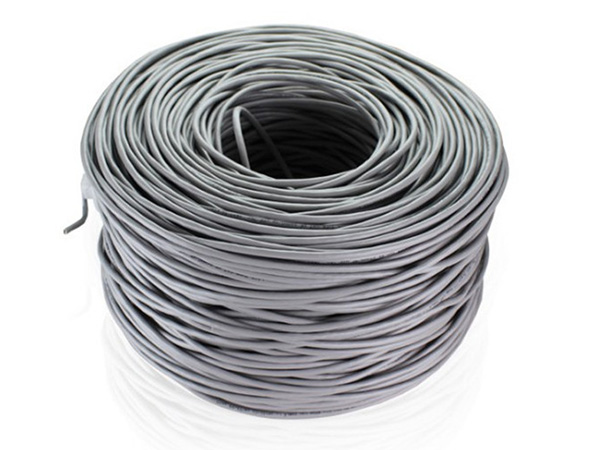
In order to reduce signal interference, each pair of twisted pair cables is twisted by two insulated copper wires, and different pairs in the same cable have different degrees of twist (that is, the number of twisted coils). At the same time, the pair in the standard twisted pair cable is twisted in a counterclockwise direction. However, there are many problems with the cables produced by some informal manufacturers: ① In order to simplify the manufacturing process, the twist density of all pairs of cables is the same; ② The winding density of two insulated conductors in the pair does not meet the technical requirements; ③ The twisting direction of the wire pair does not meet the requirements. If the above problems exist, the near-end crosstalk of the twisted pair will be caused (referring to the signal interference between two pairs in UTP), thus the transmission distance will not meet the requirements. Twisting degree of twisted pair has strict standards in production. In actual purchase, some professional equipment can be used to measure if conditions permit, but general users can only observe with naked eyes. It should be noted that the twist degree of Category 5 UTP centerline pair is denser than Category 3, and that Category 5 UTP centerline pair is denser than Category 5 UTP centerline pair
In addition to twisting the two insulated copper conductors that make up the twisted pair as required, the twisted pair in the standard twisted pair cable should also be twisted counterclockwise. Otherwise, the cable resistance will not match and the transmission distance will be limited. This is rarely noticed by ordinary users. For the twist degree and other related parameters of Category 5 twisted pair cables, interested readers can refer to the specific provisions in TIA/EIA568A (TIA/EIA 568 is the cabling standard developed by ANSI in 1996, which gives the contents of infrastructure, including cables, connecting equipment, etc., when network cabling. The letter "A" indicates the IBM cabling standard, while AT&T Company uses the letter "B" to indicate.)
3. Cable pairs
When using twisted pair as the transmission medium, Ethernet only needs 2 pairs (4-core) of wires to complete the transmission and reception of signals. There are three standards in fast Ethernet using twisted pair as the transmission medium: 100Base-TX, 100Base-T2 and 100Base-T4. Among them, the 100Base-T4 standard requires the use of all four pairs of lines for signal transmission, and the other two standards require only two pairs of lines. The most popular standard in fast Ethernet is the 100Base-TX standard, so when you buy the twisted pair used in the 100M network, do not use the twisted pair with only 2 pairs for the sake of the figure. In the American Cable Standard (AWG), Category 3, Category 4, Category 5 and Category 5 twisted pairs are defined as 4 pairs. In Gigabit Ethernet, all 4 pairs of wires are required for communication. Therefore, there should be 4 pairs of wires in the standard Category 5 cable
5. Appearance characteristics
After having the above knowledge, the following points should also be noted when identifying five types of UTP:
① Check the instructions on the outside of the cable. The words like "AMP SYSTEMS CABLE... 24AWG... CAT5" should be printed on the outer sheath of the twisted pair cable, indicating that the twisted pair is the five categories of twisted pair of AMP Corporation (the most famous twisted pair brand), in which 24AWG represents the wire number, the core wire thickness belongs to the American Standard Line 24, and CAT5 represents the five categories; In addition, there is an IBDN standard five-category network cable of NORDX/CDT company. The words on it are "IBDN PLUS NORDX/CDX...... 24 AWG... CATEGORY 5". Here, "CATEGORY 5" also means five-category cable (CATEGORY means "category" in English)
② Whether it is easy to bend. The twisted pair should be bent naturally to facilitate wiring
③ Whether the copper core in the cable has good toughness. In order to prevent the twisted-pair wire from breaking during movement, in addition to the outer protective layer, the inner copper core should have a certain toughness. At the same time, in order to facilitate the production and reliable connection of the joint, the copper core should neither be too soft nor too hard. It is not easy to make the joint if it is too soft, and it is easy to break the joint if it is too hard
④ Whether it is flame retardant. In order to avoid cable damage caused by high temperature or fire, the outermost sheath of the twisted pair should not only have good tensile properties, but also have flame retardance (you can use fire to burn the test: if it is genuine, the rubber will be soft and will not fire; if it is fake, it will catch fire at one point). In order to reduce the manufacturing cost, non-standard twisted pair cables generally use materials that do not meet the requirements to make the cable sheath, which is not conducive to communication security