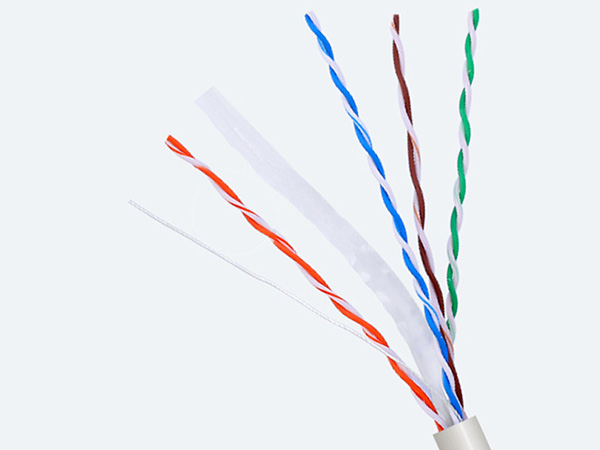
With the popularity of multimedia applications such as high-definition video and video conferencing, people's demand for network bandwidth is increasing, and 1Gbps is gradually being replaced by 10Gbps. Therefore, the ultra-five network cables supporting 1Gbps transmission are gradually fading out of people's vision. Category 6 network cables and super Category 6 network cables are common network cable products. This tutorial will introduce these two types of network cables and their application scope in detail
What are Category 6 and Super Category 6 network cables
Category 6 network cable usually refers to Category 6 unshielded network cable, which is the sixth generation standard Ethernet network cable. It complies with Category 6 standards of ISO/IEC 11801:2002 and EIA/TIA 568B. Its bandwidth is twice that of Category 5 network cable, and the transmission performance of Category 6 network cable is much higher than that of Category 5 network cable. It is most suitable for gigabit rate network transmission applications
Super Category 6 network cable is the upgraded version of Category 6 network cable, so it is also called "Enhanced Category 6 network cable", and conforms to the standards of ISO/IEC 11801:2002 and EIA/TIA 568-B.2-1. Its performance in external crosstalk and other aspects is better than Category 6 network cable. Compared with Category 6 network cable, Super Category 6 network cable has larger outer diameter, heavier weight, and larger minimum bending radius. The maximum transmission distance of Super Category 6 network cable is 100m, and it can be compatible with Category 6 and Super Category 5 network cable. The Cat 6 network cable must be grounded during use to prevent the electrostatic interference of the electrons generated by long-distance transmission from causing data packet errors. If it is common anti-static interference, only single point grounding is required. If there is strong current interference outside the network cable or for the sake of safety requirements such as protection against electric shock and lightning protection, multi-point grounding is necessary. In addition, all the hardware connected to the super Category 6 network cable must be shielded products in order to reflect its good shielding performance, including transmission cables, distribution frames and modules
What are the six types of network cables
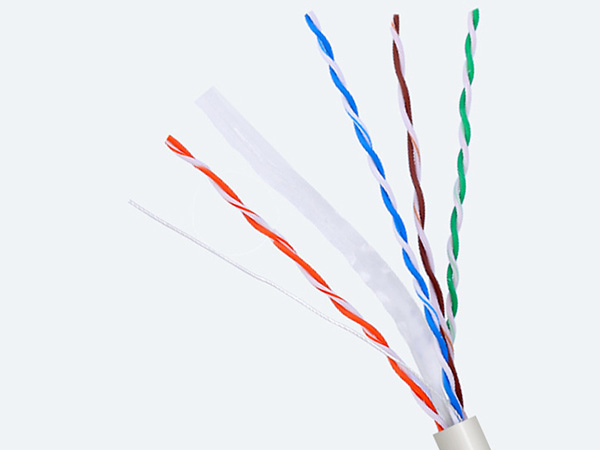
There are two types of ultra-six network cables: shielded (UTP) and unshielded (FTP), which have obvious differences in structure
1. Unshielded Cat 6 network cable. The method of increasing the distance between cores and non-metallic fillers is often used to reduce external crosstalk. Therefore, the diameter of unshielded Cat 6 network cable is large. The advantage of unshielded Cat 6 network cable is that it has no shielding layer, so the termination is more convenient and time-saving. In addition, the price of unshielded Cat 6 network cable is lower, and the price of unshielded distribution frame used with it is also lower
2. Shielded Cat 6 network cable. There are two types of shielded ultra-six network cables: U/FTP and F/UTP. U/FTP has no total shielding layer. This kind of shielded network cable has high anti-crosstalk performance, but it is troublesome to terminate. It is necessary to deal with the shielding layer of each aluminum foil wire before terminating; The total shielding layer of F/UTP is aluminum foil shielding, without wire pair shielding layer. The production process of this network cable is more complex, but its diameter is smaller than that of U/FTP network cable, and the termination process is simpler and time-saving
From this point of view, the super Category 6 shielded network cable has more advantages than the super Category 6 unshielded network cable in the application field, and is a relatively good cabling standard solution at present
How to identify Category 6 network cable and Super Category 6 network cable
Method 1: Distinguish by the appearance of Category 6 network cable and Super Category 6 network cable. Generally speaking, relevant information will be printed on the network cable and the outer package. For example, the outer skin of Category 6 network cable is marked with "CAT6", and the outer skin of Category 6 network cable is marked with "CAT6a". In addition, because the super six network cables support the network transmission of 10G Ethernet, the appearance of such products will generally have a similar identification of 10Gigabit
Method 2: Use a professional network cable tester to test
Difference between Category 6 network cable and Super Category 6 network cable
1. Speed and bandwidth of Category 6 network cable and super Category 6 network cable. Category 6 network cable is mainly used for 1Gbps network connection, while Category 6 network cable is used for 10Gbps network connection, and the bandwidth performance of Category 6 network cable is higher, its transmission frequency is twice higher than Category 6 network cable, for example, the bandwidth of Category 6 network cable is 250M, while the bandwidth of Category 6 network cable is 500M
2. The structure of Category 6 network cable and Super Category 6 network cable. The insulated cross skeleton design is added to the structure of Category 6 network cable and Super Category 6 network cable, but the Super Category 6 network cable adopts the gear shape of wire slot
3. Design of Category 6 network cable and Super Category 6 network cable. The core lay distance of Super Category 6 network cable is more dense and the conductor is thicker, so its outer diameter is larger than that of Category 6 network cable. In addition, due to the higher transmission frequency of the ultra-Category 6 network cable, its external crosstalk problem will be more serious. Therefore, the ultra-Category 6 network cable adopts a more stringent shielding design. Generally speaking, the super six network cables can be divided into F/UTP network cables and U/UTP network cables
4. ACR and PSACR parameter values in Category 6 network cables are replaced by ELFEXT and PSELFEXT in Category 6 network cables
ACR (Attenuation to Crosstalk Ratio) near-end crosstalk and attenuation difference is a very important parameter and an indicator of the signal-to-noise ratio on the line pair. When ACR=0, it indicates that the signal strength transmitted on the pair is equal to the noise strength, and the receiver cannot distinguish the useful signal from the noise signal. Therefore, the higher the frequency point corresponding to ACR=0, the better the line pair performance
ELFEXT (EqualLevelFarEndCrosstalk) and other (effective) level far-end crosstalk. Because the cable length will have a great impact on the measured FEXT value, the measurement of ELFEXT value must be used to replace the measurement of FEXT value. The EXFEXT value is actually the FEXT value minus the attenuation amount, and ELFEXT can also be understood as the remote ACR
The above two parameters have a certain relationship. ELFEXT=ACR-F, PSELFEXT=PSACR-F. In Cat6A, ELFEXT only changed its name, but the description of the parameters is clearer and more reasonable
5. Because the bandwidth of the twisted pair of the ultra-six network cables can be as high as 500MHZ, with the gradual increase of the frequency, the system becomes very sensitive to the crosstalk between adjacent cables in the same bundle, and the interference between lines is becoming more and more serious. Therefore, it is necessary to test additional parameters, namely the performance indicators PSANEXT and PSAACR-F. The larger the test value, the better the performance
6. The maximum length of the six types of network cables depends largely on the network speed and crosstalk conditions. For example, in a lower speed network such as the 10/100/1000BASE-T system, the maximum length is 100 meters, of which about 90% is used to transmit data between systems, and the remaining 10% is used for the connection itself. When the high-speed 10GBASE-T network is under ideal crosstalk conditions, the maximum cable length of Category 6 network cable is 55 meters, but when the crosstalk potential is high, it is only 33 meters. The super Category 6 network cable uses a higher standard through the full speed 10GBASE-T transmission speed of 10Gbps with a signal bandwidth of 500MHz and more than 100 meters
7. Because the central pillar support and shield of the super Category 6 network cable is larger than that of the Category 6 network cable, the cable tray cannot accommodate several super Category 6 network cable as the Category 6 network cable. Although the Ethernet cable looks strong on the outside, too much bending of the cable may damage the wiring and reduce performance. Because of their bulkiness, the super Category 6 network cable occupies more space and has a larger bending radius than Category 6 network cable
8. The cost of cable mainly depends on its length. The cost difference between Category 6 network cable and Super Category 6 network cable is small, about 20-35%. Although for a small network, this may mean that the cable cost is not high, it is necessary to consider that the connection components and jumper cables are more expensive for Category 6 network cables than for Category 5 network cables or earlier versions. This is due to the higher requirements required to ensure transmission speed and continuous performance. The most important point is that the initial investment may be higher, but the capacity and performance of the network is likely to be better and more reliable